


I retired from the school district at 62 with $3,600 a month written on a yellow legal pad, and I believed that number for two full years. My mistake was not the arithmetic. It was that I never ran a real month against it before I handed in the keys.
I am not a financial planner. I spent 31 years as a facilities manager for a suburban Ohio school district, retired in spring 2022, and have tracked every bill since. My wife still works part-time for $1,250 a month until she turns 66, and our mortgage has $61,000 left at 3.1%.
The pad had a rough budget, a Social Security estimate, and a retirement date. It had no line for a $712 health premium, and no line for a Tuesday in week five with nothing on it.
Three years in, the real month is $4,300, and what the calendar needed was a standing 8 a.m. commitment, not a bigger travel budget. Most of what showed up late was testable beforehand.
three real months on your actual number, then cash, then health coverage, and the Social Security date decided last. If a pension already covers your spending, skip most of this list.
Quick Tips Before You Start
Track three months, not a year
A yearly guess hid my $700 gap; a rolling three-month average shows it by month four.
Price coverage yourself
Get a real quote from your state marketplace before you decide the retirement date.
Book one blank weekday
Spend a Tuesday with nothing scheduled and see how the hours feel.
List every bill you will still owe
Mortgage, insurance, utilities, and the premium that used to come out of your paycheck.
Check your Social Security reduction on ssa.gov
Look up your own number instead of trusting a rule of thumb from a friend.
The money, three years in
This first group is the part I got wrong in dollars. Not the investing, not the taxes — the plain monthly number, and the two one-way choices I made in the first ninety days that I cannot undo now.
Read these four knowing that a budget written before the last paycheck is a guess, not a measurement. The fix is to treat it like one and check it against real months.
1. My first-year budget was $700 a month short

Everyone told me the same thing: once you stop working, your spending drops. Mine went the other way. I left in spring 2022 with $3,600 a month written on a legal pad; three years in, the real number is $4,300.
That $700 a month did not come from me suddenly taking up golf. Health coverage was the biggest new line, then gifts and family, then the cars – a roof leak and a used sedan both landed in year one. Travel, the one thing I had budgeted generously, came in under, because the big trip never happened.
you cannot fix a budget before the paycheck stops. You can only stop guessing at it. So take your yearly estimate and do not defend it – run a rolling three-month average of what actually left the account, and look at it once a month, not once a year.
If the gap comes in at $700, or $400, or $1,100, that is not a failure. That is the number you needed, and you found it while a salary still covered the miss.
💡 Tip: Write your retirement budget in pencil. The first three months will rewrite it for you.
| Monthly item | What I budgeted | What I actually spend |
|---|---|---|
| Total spending | $3,600 | $4,300 |
| Health coverage (pre-Medicare) | Not counted | $712 |
| Gifts and family | $150 | $275 |
| Car and repairs | $200 | $340 |
| Travel | $400 | $225 |
| Social Security at 62 | $1,880 | $1,880 |
| Pension with survivor benefit | $980 | $980 |
| Wife's part-time pay | $1,250 | $1,250 |
2. Claiming at 62 shrank my check for good

$1,880 a month. That is my Social Security check, claimed the spring I turned 62, and it is less than it would have been at full retirement age for the rest of my life.
When a $700 monthly shortfall showed up, my first instinct was to treat that check as the income I had already promised myself – the money was in the plan, so why not use it? I did not trust a rule of thumb about how much smaller the early check is. I pulled up ssa.gov and read my own reduction off my own record, because the percentage depends on your birth year and a general figure can be wrong for you by a lot.
The trade held together because two things stayed untouched: the health premium was covered, and the gap was closed. My $1,880 plus a $980 pension meant I took nothing from the 401(k) or IRA in years one and two. The $22,000 for the roof and the car came out of savings in the bank, not the invested accounts.
That is the deal I would repeat – but only under those conditions. Savings left alone early, coverage paid, gap closed. A larger spousal benefit changes the math. So does a family where people live into their nineties. Run your own record before you file.
whether my benefit statement still matches what I am being paid, whether my wife's survivor benefit on the pension is recorded the way we elected it, and whether anything about our health or her work hours has changed enough that the early claim no longer fits.
I also look at what the check would have grown to if I had waited, not to punish myself, but because a survivor benefit is set by these choices and she is younger than me.
That review takes about twenty minutes. It is the cheapest hour I spend all year, because the claim is one of the few decisions I cannot undo.
3. Cash in the bank beat the better return

I remember standing in the driveway the week the roof was finished and the used car was in it, doing the math in my head. $22,000 had left the account in year one, and not one dollar of it came from selling a fund on a down day.
Keeping the 401(k) and IRA untouched through those early years only worked because $70,000 sat in cash outside the market. That cushion bought me the one thing I could not buy later: no forced sale. It also cost me three years of growth I never saw, which I think of as the premium on that insurance.
My own sizing habit now, not a rule for anyone else: hold 18 months of actual spending in cash – at $4,300 a month, about $77,400 – and refill it after a hit. Start with three months if 18 is out of reach this year.
💡 Tip: Keep the cash in a separate account at a different bank. It is harder to spend that way.
💡 PRO TIP
The number that kept me calm
18 months of real spending in cash sounds like too much parked earning nothing. It is the price of never being forced to sell an investment at the wrong moment — and in year one, my roof made sure I needed it.
4. Two days of consulting eased the jump

Part of me wanted the clean break, and part of me was scared of it. A cash cushion stops a forced sale; it does not pay a $712 monthly premium or fill a $700 spending gap. What filled mine was two days a week of consulting, at $1,400 a month, for the first 18 months, until a project wrapped and I turned down the extension.
That came to $25,200 and it bought me a softer landing, but I will tell you the cost plainly: it kept one foot in the old identity and put off the Monday I was dreading.
If your job is the thing you most want to stop doing, skip this one. If you are not sure which camp you are in, that is a question for a fee-only fiduciary who can look at your actual numbers alongside you.
Retiring at 62 does not just shrink your income — it moves your biggest new bill from your employer's desk to your kitchen table.
— What the first three years of bills taught me
Premiums, forms and one-way choices
The second group is paperwork and premiums. None of it felt urgent at 61, and all of it was decided in the first year, most of it in ways I could not easily reverse.
A CPA, a marketplace quote, and a copy of your own pension election form are the three things to look at before the last paycheck. I got to two of them late.
5. Health coverage was my biggest new bill

The bill that scared me most before I retired was health coverage, and bridging the Medicare gap was the work: you can find your number, and finding it beats dreading it. When the consulting wound down, the $712 a month did not. For the two of us, through the state marketplace until Medicare at 65, it was the single largest cost that did not exist before I retired, and it sat there every month whether I earned anything or not.
Compare that to the $180 a paycheck that used to come out as an employee, automatically, before I ever saw it.
Here is what to set up so it stops being a monthly scramble. Get the plan on autopay from one account you do not touch for anything else, and fund that account on the same date every month, a day or two before the premium drafts. Then leave it alone. The one thing to re-check once a year is the deductible, not just the premium; in year one I shopped on premium alone and a $900 physical-therapy bill landed on me out of pocket.
Price your own household at the state marketplace rather than working from a guess. The $712 is my number, for two people, until Medicare, and it is not yours.
6. One hour with a CPA saved me a mistake

The premium was the known bill. Which account paid it, and what I drew from first, was the mistake sitting right behind it. So I paid a CPA $400 for one planning hour, and it was the best money I spent that year.
I brought three balances: the 401(k), the IRA, and the $70,000 in cash. I brought my $1,880-a-month Social Security figure and the $980 pension, and I brought my plan, which was to spend down the 401(k) first, then the IRA, then cash last.
He turned it around. Keep the cash as the buffer for one-time bills and the premium, he said, and draw from the 401(k) only after the consulting stopped.
Why now, and not next year? Because the order you draw in has consequences, and they start working the month you retire, not the month you file your taxes. Pull too much from a tax-deferred account in one year and you can push yourself into a higher bracket for no good reason. The withdrawal I had scheduled for month one never happened.
The $22,000 roof and car came out of cash instead, and the $1,400 consulting check covered the $712 premium and most of the spending gap. None of that touches your accounts the same way, and which way is right depends on numbers only you have.
Practical version: book the session three to six months before your last paycheck, bring every balance and every income estimate on one page, and ask two questions. Which account do I draw from first, and how much can I pull in a single calendar year before the tax bill changes?
If all your retirement income comes from one source, a pension or an annuity and nothing else, you can skip the CPA. Everyone else is guessing at a rule they did not write, and $400 is cheap against a mistake you cannot undo.
💡 Tip: Bring every account balance to the CPA, not just the big one. The order is the whole point.
The pension election: what each option actually bought
Single-life: $1,150/mo
- Higher check while I am alive
- $170 more every month
- Stops when I die
- Leaves my wife with nothing from it
- Right for a couple where I have the shorter life expectancy
50% survivor: $980/mo
- Lower check while I am alive
- $170 less every month — $40,800 over 20 years
- My wife keeps half if I go first
- She is younger and still working part-time
- Right for us, not for everyone
7. The Medicare forms started earlier than I expected

Put the calendar before the call and treat these forms as a sequence, not a single phone appointment. I had it in my head that the switch happened on its own the year I turned 65, the way a birthday shows up whether you plan for it or not, so I did nothing until a neighbor asked which plan I was on. That was my first miss: turning 65 triggered a file I had to open.
What the call wanted was proof in a stack I had to assemble first – the little blue book, the card with my number on it, the paper from the district naming when my coverage stopped, and the passport I dug out of a drawer. Then the phone, twice, because the first person I reached had the wrong starting month in front of her and we reset the whole file. The Part B premium now simply leaves before I see it, one more subtraction from that $1,880 check.
Point your browser at medicare.gov and ssa.gov and read your own dates there. I am giving you no deadline of mine, because the ones on my paperwork only ever applied to me.
8. The survivor election took us a whole weekend
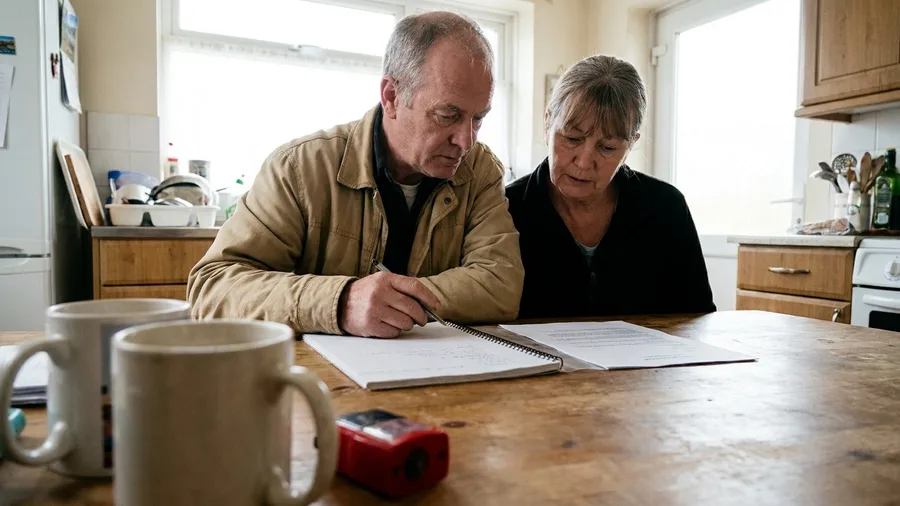
The larger number looks like free money until you picture the house with one income in it, and that picture is what kept my wife and me at the kitchen table through an entire weekend, papers spread across it, sharpener and coffee going cold.
My district offered two versions of the same pension. The single-life figure paid until only I was alive and then stopped cold; the joint-and-survivor version ran a little smaller for as long as I live and kept half of it going to my wife afterward. Here is where people get it wrong: they compare two monthly numbers in a vacuum and never sit down with their spouse and name what happens to the household the month after one of them is gone. We took the smaller one – she is younger, and she is still pulling $1,250 a month part-time until she turns 66 – and the trade cost us $170 a month, which comes to $40,800 over 20 years. That is a real sum, not a rounding error.
The other way is right for some couples, and I will say so plainly: if the pension holder is likely to have the shorter life or if the other spouse already carries the bigger income, the single-life number can be the better bet. What matters is that you decide it together and write down why, because you cannot undo it later.
A fee-only fiduciary can run the two paths against your own life expectancies if you cannot settle it at the table.
💡 Tip: Write the monthly difference on the form itself before you sign it. $170 looks small until you multiply it by 240.
The days nobody plans for
Nobody warned me about the calendar. The money surprises I could measure; the empty Tuesday was harder.
This last group is about the hours. The fix was structure and other people, not a new career.
9. Week one feels like vacation; week five doesn't

Book the standing commitment before you need it, because the crash comes sooner than the calendar suggests. The forms settled what would land in the account each month. The other side of it – what fills a Tuesday once nobody expects you anywhere – never appeared on any form, and that was the part that caught me flat.
Those first days felt like a long weekend that kept going. I stayed in bed past seven, dug into a couple of half-finished projects in the basement, and felt the odd pleasure of no commute and no call at 6 a.m. because a boiler had quit in a snowstorm. Then a rainy Tuesday about five weeks in, my wife off at work, the garage already swept clean, and I sat at the kitchen table with a cup of coffee going cold, watching the rain, and realized the only thing on my list for that day was the list itself. Nobody was waiting on me for anything.
What I bought back was structure, and it cost me nothing but a habit. Three mornings a week I now have somewhere to be at 8 a.m., a standing commitment that gets me dressed and out the door before the day can get loose. Not a job. Not a new career. A reason the alarm goes off.
The trade is real and I will name it. Those mornings are no longer mine to spend how I like, and some weeks I resent the alarm the way I used to resent the snow call. The empty Tuesday cost me more than the alarm ever has.
⚠️ COMMON MISTAKE
The trap in week five
The mistake is thinking you need a new career or a big project. Most of us just need three mornings a week that someone else is expecting us at. Book them before the novelty wears off.
10. My job title was doing more than I knew

A standing 8 a.m. appointment gives the hours a shape, but it says nothing about who you are now, and for about two months that was the harder problem. What I missed was narrower than I expected: knowing which boiler to open first, being the one whose phone rang when a door wouldn't latch. The 6 a.m. snow calls and the purchase-order approvals I did not miss at all.
Then a neighbor's cookout in June, a kid handing out burgers, and a man in a lawn chair asking what I did now. I said retired. He nodded, looked at his plate, and we all watched the grass for a while. Nobody was rude; there was just nowhere for it to go, and I stood there with no second sentence. That was the part the calendar could not fix.
So I started at four hours a week at church, Tuesday and Thursday mornings, fixing doors, shelves, and loose hinges, with my own key to the maintenance closet. That is the small start: four hours, one chore list, a building full of people who notice when the riser is level. It isn't a hobby and it isn't a career. It is someone expecting you, with a door that sticks until you get there, and it still counts.
Where the first three years went — at a glance
📅 Retired
Spring 2022, age 62
💵 Monthly gap
$700 over budget
🩺 Health premium
$712/mo until Medicare
🏦 Cash used in year one
$22,000 of $70,000
💼 Consulting
$1,400/mo for 18 months
The number to test
Run one real month at $4,300 before the last paycheck — not the $3,600 guess I used.
11. My wife and I had to redraw the house

You are not going to drive each other crazy, I promise. But the house is about to feel smaller, because being useful out in the world means coming home more, and now two people are standing in the same kitchen at noon.
That is the fear, and it is real enough. My wife still works part-time for $1,250 a month until she turns 66, so some days the place is mine and some days it is both of ours, and nobody had drawn a line where one person's day started and the other's ended.
The friction was never the big stuff. It was the kitchen counter at noon with both of us reaching for the same spot.
It was errands run together that one of us could have done alone. It was the thermostat, of all things, the quiet war of one of us nudging it two degrees.
We had three bad weeks before we sat down and wrote the thing on paper. Tuesdays apart. She takes the day, I take the day, and nobody's feelings get asked about it.
The other line: I own dinners. Not helping with dinners. Owning them, start to finish, so the question of who cooks is already answered before it becomes an argument at five o'clock.
What we would not change is dinner together every night. That was never the problem. The problem was every hour around it having no shape.
Write your version down before the third bad week, not after. Two territories, one shared table, and the rest of the day is nobody's fault.
💡 Tip: Write the arrangement on the fridge. Verbal rules get renegotiated every morning.
12. Friends who still work vanish for eight hours

Six months after my last day, I noticed the lunches had stopped. I had been seeing the same crew at the same diner on Tuesdays for years, and the invitations just quietly thinned out, because everybody I knew was still on a schedule and my free Tuesday did not line up with their work week.
The belief to drop is that retirement keeps the social calendar you already had. It does not, because that calendar was built by the workplace, and you are not in the workplace anymore.
Two friends retired around when I did, and the Thursday breakfast is the thing that stuck, the one standing date that survived. It costs about $40 a week, and I count it as part of the monthly number now. The still-working friends became weeknight and weekend people, and that is fine. One standing date beats a hundred hopeful texts.
Three things I would do differently
13. A three-month rehearsal would have caught both misses

The usual move before retirement is to build a spreadsheet of guesses and trust that it adds up, and I made that move myself: a yellow pad, $3,600 a month, a date circled, and a quiet assumption that the rehearsal was optional. That guessing is the mistake, and it is not a character flaw, it is what everyone does when the paycheck is still covering the miss.
The missing rehearsal costs nothing and is quieter than a spreadsheet. Spend one full month tracking every dollar against the $4,300 I actually spend, not the $3,600 I hoped for. The same $700 gap would have shown up with four weeks of real grocery receipts, real gifts, real car repairs, and me looking at the number before a single pension check arrived.
Spending is only half of it. I would have booked one weekday off, put nothing on the calendar, and kept it blank from 7 a.m. to dinner. That first sentence, said honestly, is the test I avoided. A rainy Tuesday in week five, coffee at the kitchen table, my wife at work, and no one expecting me anywhere, is exactly what a blank weekday booked six months early can show you in advance, for free.
There is a version for the money side, too: price the $712 a month marketplace coverage for your own household, then leave the Social Security date alone until the very end. The date is the one decision you can make last, and the spending, the cash cushion, and the premium are the parts that punish a guess, so run the month first and let the date follow it.
I would have done the month at $4,300, kept one weekday blank, priced the coverage, and made the Social Security call last, all inside my final six months of work. No employer needs to be told, and the whole thing costs nothing but honesty.
Frequently Asked Questions
Is it too late to change my retirement date if my budget is already short?
No. The date is one of the few levers you can still pull. Even three extra months of a paycheck covers a lot of the gap you are discovering. If you have already retired, the rehearsal still tells you where you stand, and the fix is spending, not panic.
Should I claim Social Security at 62 like you did?
Not necessarily. I claimed at 62 and my check is permanently reduced, which worked for me because the pension and consulting covered my gap and I did not sell investments early. Someone with a larger spousal benefit, a longer life expectancy, or no other income should run their own numbers first.
How much cash should I keep once I stop working?
My own habit is 18 months of actual spending — about $77,400 at $4,300 a month — kept in cash and refilled after a hit. That is not a rule for everyone. It kept me from selling during a dip, which was worth the growth I gave up.
What will health coverage really cost before Medicare?
Mine was $712 a month for two of us through the state marketplace. Yours depends on your household, your age and your income. Get a real quote from your own state marketplace rather than estimating — it was the biggest new bill I had.
What if my pension already covers my spending?
Then most of this list is not for you. The spending rehearsal and the cash cushion matter less when a pension covers the month. The structure problem — what to do with the days — still shows up, so keep #9 and #10 and ignore the rest.
Run the three-month rehearsal before the last paycheck
The verdict is this, and I will say it plainly: the first three years are not a cheaper version of the last paycheck. They are a $4,300 month and a calendar that needs structure, and the $700 gap is the part to test while a salary still covers the miss.
So start there. Run three real months at $4,300, not at the number on the pad. Then look at your cash cushion. Then price your health coverage on the state marketplace. Decide the Social Security date last, once those three numbers are in front of you.
If a pension already covers your spending, or your spouse keeps full-time coverage, ignore most of this list. The $700 gap and the $712 premium are my household's numbers, not yours.
Go back to the yellow pad. The $3,600 and the empty Tuesday were both guesses. Three honest months turn them into facts while the paycheck is still there to absorb what you find.
Start with one real month
Track every dollar this month at your actual number, not the guess. Compare it to your budget, and you will know more than I did at 61.