


My rent check cleared at $2,300 the same morning Maya texted me a photo of their property tax bill, and I did the arithmetic on the back of the envelope again – their principal and interest was still $1,550.
I rented a two-bedroom in Columbus for 20 years while my two closest friends bought a three-bedroom, two-bath six minutes away, and for most of that time I was certain I had lost.
Then the house sold. Everyone quotes the $505,000, but after a $190,000 mortgage balance and $30,300 in selling costs it left them $284,700. My account balance that month was $350,000.
I kept a spreadsheet from 2005 to 2025 with both households' housing costs and balances in it – receipts, closing statements, brokerage screenshots – and the 20-year answer is $65,300 in my favor.
That margin only exists because the $533 monthly gap went into an account every single month. By the end you will be able to set your own two columns side by side and see what your next five years would actually produce – and one step decides which way it tips.
| Measure | Renter (you) | Buyers (Maya and Dev) |
|---|---|---|
| Starting cash, 2005 | $36,000 invested in a taxable brokerage account | $36,000 used as $30,000 down + $6,000 closing costs |
| Monthly housing outlay | Rent averaged $1,750; $2,300 by 2025 | About $2,283 total: $1,550 P&I + $300 tax + $100 insurance + $333 maintenance |
| Total paid over 20 years | About $420,000 in rent | About $547,920 all-in housing outlay |
| What was owned in 2025 | $350,000 brokerage balance, reachable in days | $284,700 net proceeds after selling costs |
| Who ended up ahead | $65,300 ahead, before tax effects | Behind by $65,300, but held a house for 20 years |
Both started with about $36,000

Both of us walked in with $36,000, and where that money went on day one is the whole fork in the road. Maya and Dev put $30,000 down, 10% on a $300,000 three-bedroom two-bath four streets from me, and wrote a $6,000 check for closing costs. I put the same $36,000 into a taxable brokerage account and signed a lease on a two-bedroom apartment with a $2,500 deposit my landlord returned two decades later.
But I have to tell you where my money actually sat for the first eight months: in a savings account, earning almost nothing, while I worked up the nerve to invest it.
That is my first mistake in this spreadsheet, and it is the reason my early balance trailed what it should have been. If I had put the money in during month one instead of month nine, the growth on $36,000 through the early years would have been meaningfully higher by 2025. The comparison is honest anyway, because I am not going to give myself a do-over the buyers never got.
Identical starting cash is what makes any of this mean something. Nobody was richer on day one, so every dollar of the 2025 difference traces back to where the $36,000 went and what each household did with its monthly cash afterward.
One sum, two shapes. Theirs bought an asset that could only be turned into cash by selling a house. Mine bought a balance I could reach in days.
The $36,000, Split Two Ways
All figures from this household's 2005 records.
Renting cost less per month for most years

Once the upfront money was matched, the only other dollars entering either column arrived monthly, and from the first year those monthly numbers pointed in opposite directions. Maya and Dev's all-in housing outlay ran about $2,283: $1,550 of principal and interest, $300 of property tax (that's $3,600 a year), $100 of homeowner's insurance ($1,200 a year), and $333 set aside for repairs ($4,000 a year). My rent averaged $1,750 across the two decades.
That left a $533 gap, every month, in my favor.
I didn't trust myself to move it by hand, so I set an automatic transfer to the brokerage account for the 5th of each month and let it run. It fired 240 times. I want to be honest about what that $533 could have been instead: a car payment, a better apartment, one vacation a year. It was never money sitting around looking for a home, and if it hadn't left my checking account on the 5th without me thinking about it, it would have quietly become something else.
So the comparison only holds because the transfer was automatic.
Here's the part that took me years to see from the buyers' side. That $533 was never free cash sitting in their account either. For them the same money went straight into a house they were living in, month after month, whether they thought about it or not. Both of us were saving the difference. We just saved it into different places.
Rent rose to $2,300 while the mortgage stayed fixed
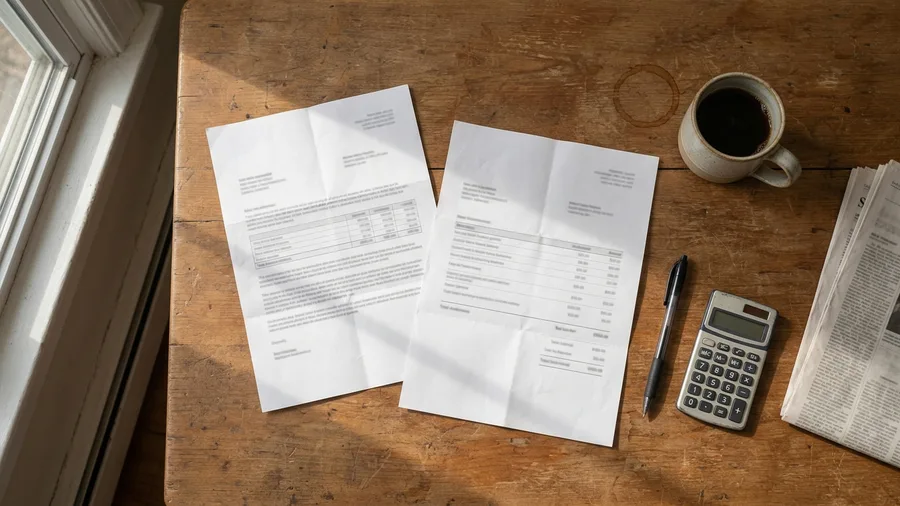
$533 is an average, and averages lie by smoothing. Rent rose every year and eventually passed what owning cost – $1,250 a month in 2005, $2,300 by 2025, an average of $1,750 over 240 months. Add it all up and I handed a landlord about $420,000.
Their principal and interest never budged. $1,550, every month, for twenty years, because it was a 30-year fixed loan and that line is a contract.
Only that line, though. I tracked their total outlay at $2,283 and not $1,550 for a reason: property tax, insurance, and maintenance all crept up over the two decades, and none of those were frozen. The mortgage was the anchor; the rest of the boat still moved. By 2025 my $2,300 rent had edged just past their $2,283 all-in, which means in the last couple of years there was no monthly difference left for me to invest at all.
That matters for how you read the $350,000. It came mostly from the early and middle years, when the gap was wide and the transfers were large. The end of the run, when rent caught up, contributed almost nothing. A renter whose rent is already at or above ownership cost today is starting in the years I finished in.
A rent check gets renegotiated at every renewal. A fixed mortgage payment is a 30-year contract, and that contract is the buyer's real monthly advantage.
💡 PRO TIP
Track the all-in number, not the payment
Never compare your rent to a mortgage payment alone. A $1,550 payment with $733 a month of tax, insurance and maintenance is really a $2,283 housing bill — and that is the only number worth putting next to your rent.
Maintenance was the buyer's hidden $4,000-a-year bill

The buyers paid $4,000 a year in maintenance and repairs – $333 a month, about $80,000 over 20 years – and I paid $0 of it. That line is the one most people drop when they compare a mortgage payment to rent, because the mortgage payment is the only housing bill that shows up on a calendar.
The roof went first, around year nine. Then the water heater, then the furnace. Gutters, the back fence, and a maple that came down across the driveway in a summer storm and cost them a deductible plus three days of cleanup. None of it was optional and none of it was fun, and all of it left their checking account straight to a contractor who did not hand back equity in return.
Add property tax at $3,600 a year and homeowner's insurance at $1,200 a year and you get $4,800 annually, roughly $400 a month that has nothing to do with the mortgage at all. Insurance on a $300,000 house is not the same animal as renters insurance on a two-bedroom apartment – their policy had to cover the structure and the liability, and the premium went up after that storm.
My landlord's repairs came out of my rent. When my water heater failed in 2014 I made one phone call, took a morning off to let the plumber in, and paid nothing on top of the rent I was already paying.
For the first two years I compared only their $1,550 principal-and-interest payment to my $1,250 rent and concluded buying was a steal. The error ran entirely in the buyers' favor until I put the other three lines on the spreadsheet – $733 a month of cost I had never been asked to pay, and the real reason my side was competitive at all.
What $2,283 a Month Actually Buys You
Renter: $1,750 average
- Rent can jump at renewal — mine went $1,250 to $2,300
- $0 for a failed water heater — one call
- Renters insurance covers my stuff, not the building
- Lose the place if I don't pay — no $190,000 debt behind it
- Flexible: leave with 60 days' notice, no sale, no $30,300 selling cost
Buyer: $2,283 average
- My $333 maintenance is a reserve — skip it and it becomes 24% card debt
- $4,800/year tax + insurance survives even after the mortgage is paid
- $30,300 to sell in 2025 — about 10% of the sale price
- Early exit in 2012: $22,000 selling costs, roughly $100,000 net
- P&I fixed until 2035 — the $1,550 can't rise
The house sold for $505,000 but netted $284,700

On the day it sold, the house turned into $284,700 in the buyers' bank account – not $505,000. The $505,000 is the closing price on the contract, and getting from there to spendable money means subtracting two things most people never say out loud.
Start with what it cost to buy: the house was worth $505,000 in 2025, up $205,000 from the $300,000 they paid in 2005. That part is real and it held. Then subtract the $190,000 still owed on the mortgage, because the lender gets paid before anyone else does.
Then subtract $30,300 for selling costs – the agent's commission, title and escrow fees, and the small concessions they had to make when the buyer's inspection came back with the furnace. $505,000 minus $190,000 minus $30,300 leaves $284,700.
I sat at their kitchen table the week the closing statement arrived, and I can tell you the mood was not the mood of the barbecue. $505,000 is the figure quoted at parties. $284,700 is what was actually in the bank.
$284,700 is also the only number comparable to my $350,000 account balance, and it is the number I put in my spreadsheet next to mine. The sale price was a guess until a buyer signed the contract – the house was worth $505,000 on the day it sold and not one dollar before, and in 2012 it was worth a whole lot less.
Mortgage principal was forced savings, not extra wealth

Before selling costs the buyers owned $315,000 of the house, and only $205,000 of that was the property actually making money. The rest was money they put in – either in one lump at the start or in pieces out of the same monthly payment I was already counting.
The $315,000 splits three ways. $30,000 was the down payment. $80,000 was mortgage principal paid down against the $270,000 loan over 20 years – that is, the part of the $1,550 principal-and-interest payment that reduced the debt rather than paid interest. And $205,000 was price appreciation, the market repricing the same house from $300,000 to $505,000.
The $80,000 came out of the $1,550 monthly payment, which was already inside the $2,283 outlay I compared to my rent every month. Calling it a bonus counts the same dollars twice – once as the payment, once as wealth.
The $30,000 down payment came out of the same $36,000 I put in the brokerage account in 2005, so it is already sitting on both sides of my ledger. Nobody conjured it and nobody doubled it.
Only the $205,000 is money the house earned beyond what they put in, and the $315,000 existed only on paper until a buyer, a contract, and $30,300 of selling costs turned it into $284,700. Mortgage principal is savings you are contractually forced to make. That is a real thing, and forced saving works – but it is saving, not a return.
Renting didn't make me money. Investing the difference did — and only because the transfer went out automatically 240 times.
— What this 20-year comparison actually proves
The renter's $533 monthly difference grew to $350,000

My pile was built from the same two raw materials: the $36,000 I started with, and the monthly difference I put in afterward. Across 240 months that monthly money averaged $533, and together with the $36,000 it came to about $164,000 of my own dollars going in. The other $186,000 of the $350,000 was growth – the part that only shows up if the money stays invested long enough to compound.
Here's the thing nobody warns you about: intentions are worth nothing here. The number reached $350,000 because a transfer left my checking account on the 5th of every month without me deciding anything. Same good intentions, no automatic transfer, and my side of the ledger is a fraction of that figure.
I got two calls wrong. I paused contributions entirely for about 14 months after 2008, and in March 2009, near the bottom, I sold part of the balance. Both moves felt defensive at the time. Both cost me a slice of the final number I can still measure, and I would not do either again.
The account was a plain taxable brokerage – nothing fancy. No inspection, no buyer, no 30-to-45-day wait, and no $30,300 of selling costs taken off the top before I saw a dollar. Reachable in days, which matters when the reason you want the money is a job loss or a medical bill, not a decision you get to schedule.
So $350,000 on my side against $284,700 on theirs is the whole liquid comparison. It holds only because the money was actually invested, every month, for two decades.
Moving after seven years would have favored renting
Twenty years is doing an enormous amount of work in that result, and it's the assumption I'd flag first to anyone running this comparison on their own life. Change the exit date and the whole picture shifts. Run the same two households selling in 2012, seven years in, and the renter comes out slightly ahead on a much smaller contribution history.
Say Maya and Dev sold that year. Selling costs would have run about $22,000, and after paying off what was still owed they'd have walked away with roughly $100,000. My account at that point held about $105,000. Slightly ahead – but nothing like the gap that opened by 2025.
The reason is transaction costs. Round trip, buying and selling ran them about $28,000: $6,000 at closing in 2005, $22,000 to get out in 2012. Every one of those dollars came out of a base that hadn't had time to appreciate yet. Seven years of payments had also put relatively little into principal, and the market hadn't handed them the $205,000 of price growth that showed up later.
There's a life cost on top of the dollar one. My lease let me move on 60 days' notice when a job change came up in 2012. Their options were to sell at a loss or become landlords from another city. If there's a real chance you move within seven years, that's the number to run before anything else.
Seven-Year Exit — The Numbers the Prose Left Out
📉 Principal paid down by 2012
Roughly $38,000 of the $270,000 loan
📈 Price growth needed to break even
About 9% just to cover the $28,000 round trip
💵 Renter's monthly gap to invest
$533 average, plus the $36,000 upfront
🚪 What the renter gave up
The $175,000 of untaxed price growth from 2012–2025
📆 The 60-day clause
Renter could leave; buyer had to sell or become a landlord
⚖️ When the math flips
Past about 10 years, appreciation outweighs the round trip
The check before you buy
If you might move inside seven years, price the $28,000 round trip against the appreciation you actually expect — not the one you hope for.
The renter had cash; the buyer had a home

I could reach my money faster – in days, versus 30 to 45 days and a signed contract for them – but which pile you can reach depends on what you're reaching for.
My $350,000 sat in a brokerage account. I could sell and have the cash settled in days, with no inspection, no buyer, and none of the $30,300 of selling costs already subtracted. Their $284,700 was the number after those costs, and getting to it required a buyer, a contract, an inspection, and a closing date that could slip.
What they had instead was a three-bedroom, two-bath house with a yard, and a $1,550 principal-and-interest payment fixed until 2035. I had a two-bedroom apartment and a landlord. My risk lived at every lease renewal, where at $2,300 the rent could go up again the following year, while their fixed payment only faced changes in tax and insurance.
Neither pile is guaranteed, and I won't pretend mine was. My balance fell hard in 2008, and their house value was a guess on paper until a buyer signed in 2025.
Tax breaks can narrow the gap, not erase it

There is one line item the $65,300 leaves out, and it is the one people quote most often as the reason to buy: the tax write-off. I sat down in March with my 2024 return and Maya's, because I wanted to see whether the deduction was the thing that closed the gap between us.
Here is what the deduction actually does. Mortgage interest and property tax only reduce your taxable income, and only for the part that pushes you past the standard deduction. Maya and Dev itemized because their interest and tax together cleared that line; the write-off cut their taxable income, not their tax bill by the same number. A $10,000 deduction at a 22% rate is roughly $2,200 back, not $10,000.
Your own figure depends on your filing status, your income, the other deductions you have, and Ohio's separate rules, which is why it comes from IRS Publication 936 and state tax guidance and a preparer, not from me.
My side of the ledger isn't clean either. The brokerage account threw off dividends and capital gains along the way, and selling any of it triggers capital gains rules of its own. The $65,300 I keep quoting is measured before taxes on both sides.
What that means, realistically: the deduction narrows the gap. It does not hand back the $30,300 in selling costs or the $80,000 of maintenance Maya and Dev paid over 20 years. The honest comparison is the after-tax one, and getting that number takes tax software or a CPA holding both returns.
Start with the pre-tax pair you can build today, then take both columns to someone who can price the deductions.
The 20-year result: renter ahead by $65,300

Set the tax question on the shelf and the pre-tax number is $65,300 in my favor: $350,000 in my brokerage account against $284,700 of net proceeds from their sale. Spread across 240 months, that is about $272 a month. The whole 20-year gap is smaller than the monthly grocery bill I stopped noticing years ago.
I want to be precise about what that number does not say. Both households had roofs over their heads the entire time. Maya and Dev had three bedrooms, a yard, and a principal-and-interest payment frozen at $1,550 until 2035; I had two bedrooms and a landlord. The $65,300 measures the money left at the end, not who lived better.
And it was the investing, not the renting, that produced it. If I had spent that $533 a month instead of transferring it on the 5th, my side would have been the original $36,000 plus its growth alone, and Maya and Dev would have finished ahead of me by a wide margin. The apartment gave me the gap; the automatic transfer, part of building actual wealth, is what turned it into $350,000.
So the conditions matter more than the verdict. Renting and investing wins when the difference actually gets invested every month and when there is a real chance you move inside seven years. Buying wins when you stay put, when a fixed payment matters to you, and when your cash flow can absorb roughly $4,000 a year in repairs plus $4,800 a year in tax and insurance without flinching.
Before you decide anything, build the full monthly ownership cost for the place you would actually buy: principal and interest, property tax, insurance, and a realistic maintenance figure. Set that total beside the rent on a comparable apartment. That one comparison tells you what your own gap would be, and whether there is anything there to invest.
Frequently Asked Questions
Is it really cheaper to rent than to buy?
Not by the payment — by the all-in cost. In this example the rent averaged $1,750 against a true ownership cost of $2,283 a month once tax, insurance and maintenance were included. Run your own numbers the same way: principal and interest plus annual tax, insurance and repairs divided by twelve.
How long do you have to stay in a house to beat renting?
Long enough to outrun the round-trip transaction costs, which were about $28,000 in this case. Selling after seven years left the buyer roughly break-even against the renter; the buyer's clear advantage only arrived late in the 20 years. Under seven years, assume the costs eat most of the gain.
What if I rent and don't invest the difference?
Then you are paying rent and getting nothing back, and the math turns against you. In this example spending the $533 instead of investing it would have put the buyers ahead. Automate the transfer for the day after payday, or the comparison never starts.
Do tax breaks make buying clearly better?
They narrow the gap, they do not erase it. Mortgage interest and property tax only help if you itemize above the standard deduction, and a deduction reduces taxable income rather than tax dollar for dollar. Get your own figure from a tax preparer or IRS Publication 936.
Which is safer if I might lose my job?
The renter's position is more flexible — 60 days' notice versus a sale at a cost of roughly 6% or more. The buyer's position is more predictable — a fixed principal-and-interest payment that does not reset at renewal. Both have risk; pick the one you can actually absorb.
How do I compare buying and renting where I live?
Build the full monthly ownership cost — principal and interest, property tax, insurance, and a maintenance allowance — and set it against the rent on a comparable place. Then add up the upfront cash on both sides. That single exercise tells you more than any rule of thumb.
Which Side of the $65,300 You Land On
over these 20 years in Columbus, I came out $65,300 ahead by renting and investing the difference, and that margin is thin enough that it is a behavior result, not a housing result. The investing did the work, not the renting.
Go back to the moment that started all this, my $2,300 rent check against their $1,550 payment locked in until 2035, and remember the fixed payment was only part of their $2,283 monthly outlay. The other $733, the taxes, insurance and maintenance, is what made my side competitive.
Given the same $36,000 and the same 20 years, I would rent and invest again, but I would start the automatic transfer in month one instead of month nine and leave it alone through 2009. The choice is not between a house and an apartment. It is between two sets of habits, and my spreadsheet was decided by the $533 that showed up every month.
Run your own two-column version tonight
Open a note, put your rent in one column and the full ownership cost of a comparable house in the other. That is the whole decision in one screen.