


Getting this wrong costs years, not months – two years of retraining for a title you cannot stand, plus a graduate degree you never needed. The famous six-figure jobs come with debt, hours, or both.
You walk in earning $60,000 to $80,000, burned out, and you have scrolled a dozen lists naming the same five roles. The useful question is not which title pays the most. It is what the week actually costs.
The fourteen here pay $101,000 to $122,000 base on 40-hour weeks with employer benefits, none needs a graduate degree, and eleven carry no emergency on-call. The pressure does not vanish – it moves to quotas, audit windows, live accuracy, monthly close, route judgment, builder schedules and sponsor deadlines.
So name the load you can tolerate – clients, desk, school, unpredictability, conflict, repetition – and check the day, the entry cost and the catch before you shortlist. By the end you can rule out most of the fourteen and pick two.
You are not applying to anything today.
Quick Tips Before You Start
Check the catch first
Every job below has one honest catch. Read it before you fall for the pay number.
Compare entry cost
Certificate routes run $500–$9,000; experience routes take 2–3 years in an adjacent job.
Count the deadline clusters
Monthly close, filing windows, sponsor cycles — ask how many crunch weeks per year.
Message one person doing it
Find the professional association for the title and ask a member what the week actually feels like.
1. Clinical Documentation Integrity Specialist

You read other people's charts and make them say what the doctor meant. No patients, no waiting room, no phone calls from anyone in distress. A fixed caseload, a screen, and a stack of records that has to come out accurate every time.
A family member of mine took this route after eleven years of bedside nursing and was done with twelve-hour shifts. She moved into her hospital's documentation team at $108,000, working forty hours and going in two days a week. I watched her trade the physical exhaustion of the floor for a chair and a very different kind of tired.
The day is fifteen to twenty-five charts. You read the physician's note, spot where the documentation does not support the code, and send a written query back asking for clarification. By afternoon the box of records has thinned and the questions have piled up on the other end. This is the part nobody warns you about: physicians do not love being asked, and some answer slowly.
Once a month you sit in an audit meeting and defend the records. Someone reads your work against the coding rules and asks why you chose what you chose. If your answer holds, the chart stands. If it doesn't, you fix it and learn the rule you missed. That meeting, not the hours or the on-call you gave up, is where the pressure actually lives.
Getting in usually means having an RN, RHIT or coding background already, then adding the CDIP certification at about $2,500 over roughly six months. Most people are hired off a hospital's own finance or coding side, so the move is lateral, not cold. You are not starting over; you are changing floors inside a building you already know.
This is the wrong job for anyone who needs to see their win land. When documentation is done right, nobody notices. The chart is clean, the audit passes, and the day closes with no applause and no thank-you. The reward is a quiet week and a paycheck that clears $108,000, not a room full of people telling you that you did well.
Check yourself against one question this week: can you do careful, invisible work and feel fine about it? If the answer is yes, look up your hospital's documentation team. If you need visible wins, keep going down the list.
💡 Tip: Ask your hospital's CDI manager for a shadow day before you pay for the certification.
| Job | Base pay | Entry route and cost | What the week is like | Who should skip it |
|---|---|---|---|---|
| Clinical Documentation Integrity Specialist | $108,000 | RN/RHIT/coding + CDIP, ~$2,500, 6 months | 40 hrs, hybrid, 15–25 chart reviews | People who need visible wins |
| Patent Examiner | $118,000 | Bachelor's in engineering or hard science | 40 hrs, remote after training, 3–5 applications | People who hate a production quota |
| Metrologist | $104,000 | 2-year instrumentation certificate, ~$6,000 | Day shift, lab, queue of calibrations | People who want variety |
| Catastrophe Risk Modeler | $115,000 | Bachelor's + SQL + one scripting language | Hybrid, 40 hrs, seasonal peaks | People who can't defend a model |
| Building Automation Controls Programmer | $106,000 | 2-year HVAC controls cert, ~$8,000 | 70% desk, 30% site, one metro | People who need to be home by five |
| Regulatory Affairs Specialist | $116,000 | Bachelor's + RAC, ~$3,000, 9 months | Hybrid, 40 hrs, submission windows | People who can't say no |
| Commercial Real Estate Appraiser | $112,000 | Trainee slot + state credential, 18–24 months | Solo, 2–3 inspections/week, 30–40 page reports | People who dislike driving |
| CART Captioner | $102,000 | $6,000–$9,000 program + 1 year practice | 20–25 billable hrs, live accuracy | People who can't focus under pressure |
| Cybersecurity Governance and Compliance Analyst | $122,000 | 2–3 yrs IT/audit + Security+ or CISA, ~$1,500 | Hybrid, 40 hrs, no on-call | People who want to break into systems |
| Division Order Analyst | $105,000 | 2–3 yrs land/title/royalty accounting | Hybrid, 40 hrs, month-end close | People who need each week different |
| Elevator Inspector | $101,000 | Mechanic/construction background + state credential | Route-based, solo, 4–6 inspections/day | People uneasy in a pit or shaft |
| Demand Planner | $103,000 | Bachelor's + 2 yrs planning, CSCP ~$2,000 optional | Hybrid, 40 hrs, one heavy week per cycle | People who take forecast error personally |
| Audiovisual Systems Designer | $107,000 | 2-year electronics/AV cert + CTS, ~$500 | Hybrid, 40 hrs, occasional site surveys | People who need to finish tasks |
| Research Grants Manager | $104,000 | 2–3 yrs research admin + associate's/bachelor's | Hybrid, 40 hrs, 4–6 deadline clusters/year | People who can't chase a professor |
2. Patent Examiner at the Patent Office

A patent examiner reads applications in one narrow technology and decides whether the claims are genuinely new, and the case count runs the week instead of a supervisor. Base pay sits around $118,000 at the mid-level on a 40-hour week, with remote work opening up after training and federal benefits and a pension behind it. A typical day is three to five applications: searching earlier patents, then writing either an allowance or a written rejection that has to stand on the record.
Mark the calendar for a monthly look at your own numbers rather than a yearly one. Sit down on the last Friday of each month and count three things: how many cases you closed against your production quota, how many hours the searching actually ate, and how often you had to reopen a case you thought was finished. When those counters run hot or the reopen pile grows, you know the week needs adjusting before a reviewer tells you.
The catch is the count itself. Nothing about this work answers to a client or a pager, but a visible production figure follows you like a second shadow, and a slow case drags the number down no matter how carefully you read it. First year is a steep climb, too: a bachelor's in engineering or a hard science gets you hired, then the agency trains you from scratch. If deadlines you cannot argue with wear you down, that is the load to test here.
💡 PRO TIP
The load question beats the pay question
Ask every contact one question: what part of the week do you dread? Their answer tells you more than the salary band.
3. Metrologist in a Calibration Lab
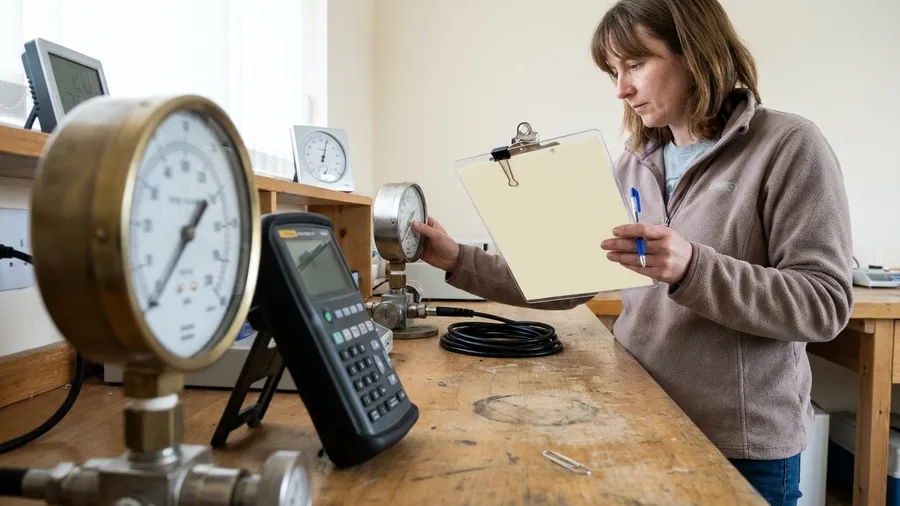
Price the certificate before anything else. A two-year instrumentation or electronics program runs about $6,000 at a community college, and from there employer training carries you to a first calibration role in roughly 18 months. That is the whole bill, and it is why this one is worth pricing this week if a lab bench sounds like a place you could sit.
The work itself is slower and quieter than a quota-driven desk. An instrument comes in, gets measured against a known standard, and leaves with a certificate saying it can be trusted to a stated tolerance; the room's temperature and humidity get checked on a schedule because the readings depend on them. Pay is $104,000 on a day shift, lab-based, 40 hours, and the emergency call never comes.
The honest reservation is sameness. A factory sends the same gauge back every year, and the certificate you write in March looks a lot like the one you wrote last March, so the pressure moves into holding tolerance rather than chasing a new problem. If repetition grates on you, this is a fast rule-out. If precision is the part of a job that settles you, start with the certificate.
💡 Tip: Ask the lab manager which certificate their last three hires held before you enroll.
The six-figure paycheck is not the reward for tolerating stress. It is the price the market pays for a specific load, and you get to choose which load.
— The lens this whole list is built on
4. Catastrophe Risk Modeler for Insurers

Two years. That is roughly how long it takes a working analyst to get fluent in the vendor models that price hurricane, earthquake and wildfire risk, and the degree does not have to be in data science – economics, math or geography all work.
The job itself is this: an insurer holds a book of policies along the Gulf Coast, and the modeler runs the storm and quake models, adjusts the assumptions for what this particular book actually covers, and writes a two-page summary an underwriter who has never opened the software can act on. Base pay is $115,000, hybrid, 40 hours, and the heaviest months are December through January and May through June, when the annual and mid-year reviews land. You need working SQL and one scripting language to move data around. The insurer teaches you the models themselves.
two quiet months for building and cleaning your own assumption library, two heavy months for the review cycles, and the rest for the routine runs and the summaries. Write down every assumption you changed and why, in one sentence each. That sentence list is what you bring to the meeting where a senior colleague who has never run the model tells you the number is wrong.
The seasonal peaks are not a surprise. They are on the calendar a year ahead, which means you can plan a vacation around them.
⚠️ COMMON MISTAKE
Do not confuse low-drama with low-focus
Captioning, patent examining and audit work are quiet, but each one judges you on accuracy. If you need a job where mistakes are forgiven quietly, none of these three is it.
5. Building Automation Controls Programmer

It is easy to assume any job with a mechanical room in it is all ladder work and no thinking, or the opposite – a desk job with a site visit bolted on. This one is genuinely split: roughly 70 percent at a screen and 30 percent on site, inside a single metro, for $106,000 base on 40 hours.
The desk part is writing the control sequences that tell a building's heating, cooling and lighting when to run, then reading trend logs to see whether the building actually did what you told it. The site part is walking into a mechanical room with a laptop and proving the sequence works while the equipment is running.
You can start this smaller than the job listing suggests. A two-year HVAC controls certificate runs about $8,000, or an electrician background gets you hired as a junior programmer by a control integrator or a utility. Either way the first real credential is a single building you can point to and say you commissioned.
That is the small start: one sequence, one mechanical room, one trend log you can explain to somebody else. Nobody hires a junior programmer off a certificate alone – they hire the person who can describe the last sequence they wrote and what went wrong with it.
The one thing to know before you commit is commissioning crunch. During a project's final weeks you may not be home by five, and the schedule belongs to the builder, not to you.
6. Regulatory Affairs Specialist in Medical Devices

The line you will hear about this job is that it is filing. Someone has to keep the binder in order, the story goes, and anyone organized can do it. That version of the job does not exist.
What actually fills the week is the moment a change comes through that the file does not support. A supplier swaps a material, or a design change lands that touches the labeling, and the regulatory specialist is the person who sits across from the engineer who made it and says the submission does not cover that yet. The engineer has a launch date. The specialist has a document that says no. You are not filing paperwork; you are the brake on a moving product, and you hold the brake against people you eat lunch with.
The pay is $116,000, hybrid, 40 hours, with no on-call. The work clusters around submission windows rather than arriving at random: a few intense weeks when a filing is due, then a stretch of reviewing labeling and reading change requests against what the file already says. The stress is not hidden in overtime. It is in the conversation where a colleague asks you to sign off and you do not.
The path in usually runs through the industry rather than the classroom. Many specialists start in quality or clinical roles at a medical-device maker, learn the file from the inside, then add the RAC certification, which costs about $3,000 and takes roughly nine months of study. A bachelor's is the floor; a graduate degree is not required, and nobody will ask for one.
What makes the belief about paperwork so wrong is that paper is the quiet part. The loud part is the audit, where you sit in a room and defend a decision you made eighteen months ago to a regulator who has the document in front of them. That is a different load than a client quota or an emergency pager, and it is the one to test yourself against.
Ask honestly whether you can say no to a colleague you like and then still hold the line when the auditor arrives. If the answer is yes, this role takes the conflict off your evenings and puts it into a known window. If the answer is no, no amount of filing skill will make the audit room comfortable.
That is the real trade here: steady hours and a quiet desk, in exchange for being the person who has to be the obstacle when the schedule says ship. The work is honest and the pay is real. Whether it fits depends on whether you can live with being the brake.
💡 Tip: Ask to sit in on one internal audit before you commit to the RAC.
7. Commercial Real Estate Appraiser

Client pipeline, no commission-only scramble. Commercial appraisers get assignments from lenders and asset managers who need a number on a building, so the work arrives whether or not you are charming on the phone.
This is the same care with documents that regulatory work asks for, moved out of a meeting room and into a car. You pull up to a strip center with a clipboard, walk the lot, photograph the roof and the parking count, then drive to the next one – two or three properties a week, each one becoming a valuation report that runs 30 to 40 pages by the time the comparables are in.
The catch is that the volume is yours alone. Nobody splits the file with you, and a base-equivalent of $112,000 assumes you keep producing; appraisers paid per job typically take home 40 to 50% of the fee, which means a slow quarter is a lean quarter. Getting in costs time too – a trainee slot under a certified appraiser, then your state's credential, and 18 to 24 months before you are signing your own reports. Check your state appraiser board for the current trainee hours, because they move.
And roughly a third of the week is a car and a clipboard. If you dislike driving, this is the wrong trade, full stop.
For the reader who wants the audit discipline without the conference-room pushback, though, it is a fair swap: the stress narrows to your own report quality and the paperwork the state wants, and nobody is arguing with you about a shipment date.
8. CART Captioner for Live Events

I watched a deposition captioner correct three dropped syllables during a speaker's two-minute answer, without the room noticing, and the transcript landed on the attorney's desk by 8 a.m. the next morning. That is the real shape of the work: solo preparation up front, then a live performance judged on every word, one client in the room, two assignments a day.
The setting sounds high-pressure, and it is — but the pressure is accuracy, not emergencies. For a full book of work the pay runs $102,000, billed at $110 to $160 an hour for 20 to 25 billable hours a week.
What makes it manageable is what you set up before the assignment ever starts. A steno dictionary of names, acronyms and jargon loaded for the specific client, a second screen for the real-time feed, and a session log that captures the audio so the cleanup is a review, not a scramble. Build those once for a client type, and you are not relying on willpower mid-session.
The honest cost: you cannot step out mid-assignment, and a lag or a bad word is visible in real time. A two-year captioning or court reporting program costs $6,000 to $9,000, plus about a year of speed practice before anyone hires you. Low-drama, not low-focus — rule yourself in only if you can hold that concentration for a full shift, then automate the rest.
9. Cybersecurity Governance and Compliance Analyst

Start with the job you have now and name the pager. The role that follows the on-call rotation and the incident call is not the only security job available — governance and compliance pays $122,000 on a hybrid 40-hour week with no on-call rotation, and moves the pressure to evidence, policy refresh and a meeting where you tell a team its access review is late. If live captioning's exposure is the visible performance in front of a client, this role trades that for internal persistence, and the clock is bureaucratic rather than immediate.
The window worth noticing is the experience base. Most hires come from two to three years in IT, audit or compliance, then add Security+ or CISA study material at about $1,500. The longer you wait, the more your adjacent years look like a different career instead of the qualification. The opening is widest while you are still inside the IT or audit work and can say 'this counts.'
So this week, before you apply for anything, open a document and list the audit, access review or compliance tasks you already do. Then price the study material. The first step is free, and it is the one that starts the clock.
On-call vs. no on-call on this list
No emergency on-call
- Clinical Documentation Integrity Specialist
- Catastrophe Risk Modeler (seasonal peaks only)
- Cybersecurity Governance and Compliance Analyst
- Research Grants Manager (deadline clusters only)
Pager or live-response duty
- Building Automation Controls Programmer (commissioning crunch)
- CART Captioner (live accuracy, cannot step out)
- Elevator Inspector (same-day report, solo safety call)
10. Division Order Analyst in Oil and Gas

The first time I read a division order, it was a two-page spreadsheet with six names and decimal interests running four places past the point.
A division order is the ownership map behind an oil or gas well: it lists who holds what fraction and therefore which share of the royalty check goes where. The analyst works those decimals out from leases and title opinions, then makes sure the money lands with the right person, which is why the owner on the phone at 10 a.m. asking why last month's check was short is really asking whether your math held. Base is $105,000, hybrid, 40 hours, and the crunch is month-end close, not a pager.
If that sounds like too much to walk into cold, shrink it: pull one sample division order from your state's oil and gas commission site and read it, or ask a landman you already know what title work actually looks like on a Tuesday. Two to three years in land, title or royalty accounting gets you hired, or a bachelor's plus an entry analyst seat. What it won't suit is anyone who needs every week to look different, because close week is the same week every month.
11. Elevator Inspector for a City or State

The belief is that inspecting elevators means riding up and down all afternoon and signing a form.
It is the opposite: the job is solo judgment with real physical risk underneath it, and that is exactly what makes it worth understanding before you apply.
You test the equipment on a scheduled route, then file the report that decides whether it stays in service. A day runs four to six inspections, each one a ride test, a check in the pit and a look through the machine room, with the paperwork submitted before you go home. In many cities and states the post comes with a public pension, which is part of why the pay of $101,000 over 40 hours holds up against louder titles.
The calm in the job description is not the calm in the shaft. An inspector who clears a car that later drops someone has made a judgment call alone, and no colleague is standing beside the machine to second-guess it. If being by yourself in a pit at 8 a.m. sounds like relief from an open-plan office, this is a good fit. If it sounds like the thing you would dread, it is the right week to rule it out.
Most people come in from elevator mechanic or construction backgrounds. Credentialing is not federal; each state runs its own, so check your state's elevator safety board for what trainee hours it currently accepts before you plan anything around this.
The people who get this wrong skip that check, start a certificate program, then learn six months in that their state wants two years of mechanic hours first. Read the board page first, then decide.
💡 Tip: Ride along with a city inspector for one day before you commit to the credential.
Elevator Inspector — What the Listing Won't Tell You
📋 Trainee hours
Varies by state board — could be 0 or 2+ years of mechanic time
🗺️ Route size
4–6 inspections a day, report filed before you clock out
⚖️ Liability
You alone sign off on a car staying in service
📞 Best next step
Call your state elevator safety board before paying for any course
📍 Remote/hybrid
No — site-based in one metro
Order of operations
Board rules first, certificate second. Most people do it backwards and lose six months.
12. Demand Planner in Supply Chain

The quiet worry is that forecasting is not a real job, just a spreadsheet with a title. It is real: you decide how much of each product the company should make or buy next quarter, then defend the number to sales and finance. The pay is $103,000, hybrid, 40 hours, with one heavier week each planning cycle. The day is cleaning sales history, running the forecast, and a two-hour meeting where sales argues every number upward.
The part that decides whether this is for you is that the forecast is always wrong, and the job is being usefully wrong. If that idea stings, skip it. A quick conversation first is worth it: ask someone already planning how much of that meeting is defense versus decision, what the CSCP course at about $2,000 actually bought them, and whether two years in planning or supply chain is the shortest real path in.
Inspection is solo and route-based; this returns you to a desk and replaces physical judgment with forecast defense in meetings, so the load you are trading for is being argued with. Stress sits in meeting defense and forecast error, not on-call.
13. Audiovisual Systems Designer

A project that runs fourteen months is not a sign the job is going badly. Classrooms and boardrooms get built on a contractor's calendar, and the drawings move through reviews, revisions and a site that is still a shell when the first survey happens. The design work is steady; the finish line just belongs to someone else.
The title covers a specific set of drawings: speaker placement, display size and sightlines, and the control logic that ties the room together, all written up as a specification an installer can build from without calling to ask what you meant. The week is roughly 40 hours, hybrid, at a $107,000 base, and it splits between CAD time, the device schedule that lists every part and model number, a call with the architect about ceiling height, and occasional site surveys while the walls are still open.
Most people arrive from the install side. A two-year electronics or AV certificate, then a few years on an integrator's crew pulling cable and hanging screens, then the CTS certification at about $500, and the move to a desk follows.
The stress sits in the schedule and in commissioning, the visit at the end when the room has to actually work. When the review comes up, check three things: whether the drawings held up against what got installed, how many change orders traced back to something the spec missed, and whether the commissioning visits landed on the dates you were given or slid with the builder. If the specs keep surviving contact with the site, the load is one you can carry.
14. Research Grants Manager at a University

You are not the one writing the proposal. You build and guard the money and the paperwork behind it, so the professor can stay in the lab.
Four to six deadline clusters a year set the rhythm, following the sponsor's calendar, on a 40-hour hybrid week at $104,000. Take the willpower out of it: set submission checklists and budget templates for each sponsor once, put every deadline on a shared calendar with reminders at 30, 14 and 3 days, and leave the chasing to the system instead of your memory.
The day itself is a budget built beside a professor, a submission checked line by line against the sponsor's instructions, and a spending question settled with the finance office. The entry is two to three years in research administration, sponsored programs or departmental finance, plus an associate's or bachelor's degree. The one thing to know going in: if you cannot ask a professor for the same document three times in one week without dreading it, this load will grind you down.
A week of comparing fourteen jobs
Frequently Asked Questions
Do any of these jobs require a graduate degree?
None of the fourteen requires a master's or doctorate. The entry routes are certificates ($500–$9,000), bachelor's degrees in a specific field, or two to three years in an adjacent job. The patent examiner role requires a bachelor's in engineering or a hard science, but no graduate degree.
Which of these is the fastest to enter if I have no relevant background?
The clinical documentation integrity specialist is the fastest certificate route at about $2,500 and six months, but it usually needs an RN, RHIT or coding background first. If you have none of those, the AV systems designer route is the shortest from zero — a two-year certificate plus the CTS certification at about $500, hired off an install crew.
Are these jobs really low-stress, or just slow?
They are not stress-free. Each one carries a specific load: a production quota, a live-accuracy requirement, an audit conflict, a deadline cluster, or a solitary safety call. Low-stress here means no emergency on-call and no client hustle for eleven of the fourteen. Read the catch line for each one and decide whether that particular load is one you can live with.
How do I verify the pay figures before I commit?
Ask the professional association or the hiring manager for the current salary band. The base pay figures here are typical examples, not guarantees, and they vary by metro and employer. A hospital in a high-cost city may pay more; a rural employer may pay less.
Can I do any of these part-time or remotely?
Four of the fourteen offer hybrid or remote work, and three are route- or site-based inside a single metro. The patent examiner role allows remote work after training. Captioning is billed hourly and can be built into a part-time book of work, but it is not a remote desk job in the traditional sense.
Fourteen Jobs, One Honest Shortlist
The verdict is plain: there is no stress-free six-figure job on this list. What it offers is a different load – 40-hour weeks, benefits, no graduate degree, no emergency on-call in eleven of fourteen, deadlines that arrive on a known cycle. Not no pressure. Sorted pressure.
Want no clients? Patent examiner, metrologist, appraiser, elevator inspector, research grants manager. Want no desk? Elevator inspector first, then the controls programmer's site weeks and the appraiser's car-and-clipboard rounds. Cannot go back to school? The experience routes: clinical documentation, regulatory affairs, cybersecurity compliance, division orders, research grants. For more well-paid roles that skip the degree requirement entirely, browse six-figure jobs without a degree before you write off a career change. Need the fastest entry? CDIP at roughly $2,500 and six months, or Security+ study material near $1,500 on an IT, audit or compliance base.
For the CDI pick, open the AHIMA job board and message one specialist this week about chart mix and physician-query volume. For the compliance pick, a local ISACA chapter, asking how they moved into the no-on-call policy side. The next six-figure step may be the quieter title, chosen by the load you can carry.
Shortlist two and send one message this week
Open the professional association page for your top two titles and find one member to contact. That is the whole next step.